









Outlet stores have long served as a crucial channel for moving aged inventory and protecting brand value in full-price locations. But managing outlets effectively requires a strategic approach that treats them as a distinct phase in your product's lifecycle, not just an afterthought. Here's how Toolio enables a planning methodology that gives you full visibility and control over the full-price-to-outlet transition.
The Core Concept: Treat Retail Outlets as a Lifecycle Stage, Not a Buying Channel
The key shift in this planning approach is simple but powerful: don't buy receipts for outlet stores. Instead, treat outlets as the natural next stage after full-price sell-through. Your product launches in full-price channels (web and retail stores), sells through its primary lifecycle there, and then transitions to outlet locations to sell off remaining inventory.
This approach relies on three fundamental mechanics in Toolio:
1. Use Launch and Phase-Out Dates to Control When Products Shift to Outlet
Every product has a planned lifecycle at full-price channels. For example, a style might launch on November 1st and be planned to exit full-price by January 1st. By setting a phase-out date on your outlet cluster (matching that January 1st date), you ensure that no new receipts are purchased for outlet locations. The outlet plan begins only after the full-price window closes.
2. Rely on Shared Inventory to See What Flows to Outlet
Toolio's shared inventory concept is what makes this work seamlessly. As you plan demand and receipts for full-price channels, the platform automatically projects how much inventory will remain at the end of the full-price period. That projected leftover inventory becomes the starting point for your outlet sales plan, no guesswork required.
3. Plan Outlet Sales Using Only Carryover Inventory
Once the full-price phase ends, outlets pick up where mainline left off. They continue selling using whatever inventory was carried over, with no additional receipts planned. When it's time to execute, planners use allocation tools to transfer that projected leftover inventory into outlet stores.
How the Full-Price to Retail Outlet Transition Works in Toolio
Let's walk through a simplified example:
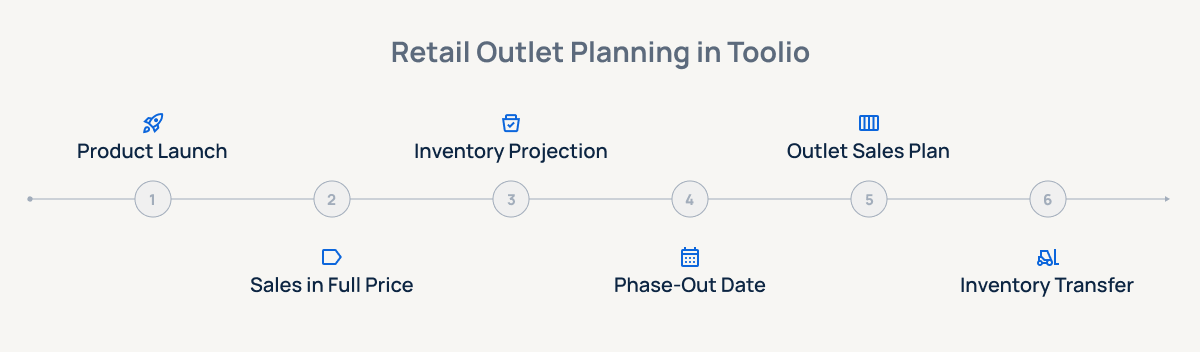
- Nov 1: Product launches in full-price web and mainline stores. Receipts are planned only for these channels.
- Throughout Nov–Dec: Sales occur at full price. Toolio continuously projects remaining inventory.
- Jan 1: Full-price phase ends (phase-out date). Toolio shows you how many units are left.
- Jan 1 onward: Outlet locations begin their sales plan using the carryover inventory. No new buys are added for outlet.
- Execution: Via allocation, allocators transfer the identified leftover inventory from warehouses or full-price stores into outlet locations.
The Strategic Benefits You Get from This Approach
This outlet planning method delivers several advantages:
Complete Visibility Across the Product Lifecycle
You can see the full journey of your inventory, from initial launch through full-price sell-through to final outlet disposition, all within a single planning framework.
Controlled Buying Behavior
By explicitly excluding outlets from receipt planning, you avoid over-buying or creating dedicated outlet inventory that could cannibalize full-price sales or dilute your brand positioning.
Accurate Demand Planning
Outlet sales don't distort your full-price forecasting. You can configure Toolio to exclude outlet performance from core demand models, ensuring your forecasts reflect true full-price customer behavior.
Flexibility in Identifying Outlet-Eligible Inventory
Toolio supports tagging inventory as "aged," "inactive," or "outlet-eligible" based on lifecycle attributes, not just product master data. This means the same SKU can be full price in one location and outlet-eligible in another, depending on its sales velocity and age in that channel.
How to Set Up This Workflow in Toolio
To implement this approach in Toolio, you'll work across a few key areas:
Merchandise & Assortment Planning
Plan demand, sales, and receipts exclusively for full-price channels. Exclude outlet from receipt plans so you're not buying into that channel directly.
Allocation
Set up outlet stores as locations within Toolio's allocation workflows. Use the platform's transfer capabilities to move inventory from warehouses (or, coming soon on our product roadmap: from store to store) based on your outlet-eligible flags.
Forecasting Configuration
If desired, configure your channel groups and planning levels to keep outlet sales and inventory out of your full-price demand forecasting entirely.
Why This Lifecycle Model Creates Better Outlet Results
This planning approach transforms outlets from a buying problem into a lifecycle management opportunity. Instead of treating outlets as just another channel that needs receipts, you manage them as the natural endpoint of your product's journey, a place where inventory goes to sell off after completing its full-price run. The result? Tighter inventory control, clearer visibility into product performance across channels, and a planning process that aligns with how your business actually operates: full-price sell-through first, then outlet sell-off. All within Toolio's unified planning environment.


