











Retail planning is entering a new era. The new normal is now “never-normal.” You're managing thousands of products across multiple channels and regions. And your team can't keep up with the data.
This is where agentic AI comes in.
Agentic AI is different from the AI tools you've used before. It goes beyond simple recommendations. It makes decisions and takes action on its own. Think of it as hiring thousands of junior analysts who work 24/7, never get tired, and can process massive amounts of data in seconds.
Importantly, you remain in the driver's seat. While these agents are powerful, they operate within the guardrails you define. You can choose to let an agent act autonomously for routine tasks, or you can build in specific checkpoints that require human approval before any action is taken. This ensures that while the AI handles the heavy lifting, the ultimate strategic control always stays with the planner.
What Is Agentic AI?
Agentic AI refers to autonomous software agents that work toward specific goals you set. You give an agent a goal like "minimize stockouts while maximizing revenue." The agent continuously monitors data, makes decisions, and executes tasks to achieve that goal.
Here's what makes it different:
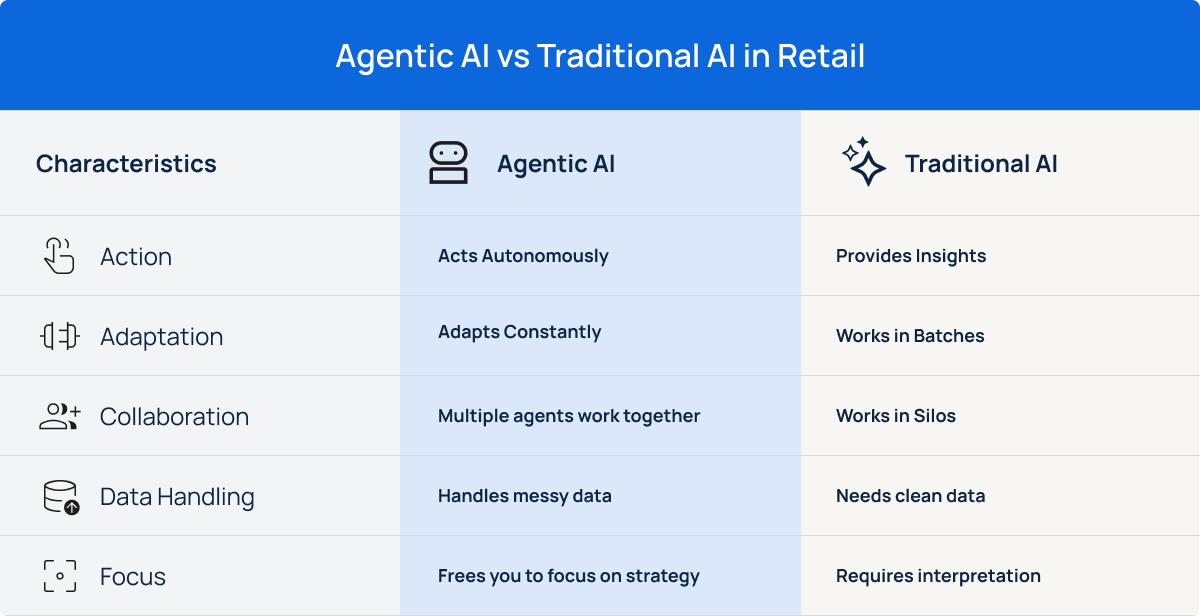
It acts on its own.
Traditional AI tells you what to do. Agentic AI does it. If it detects a stockout risk, it doesn't just alert you. It recommends how much inventory to transfer or reorder, from where, and actions based on your approval.
It adapts constantly.
Agents learn from results and adjust their approach. If one strategy fails, they try another. They work continuously, not just during weekly planning cycles.
Multiple agents work together.
You can have specialized agents for pricing, demand forecasting, and replenishment. They communicate with each other to coordinate decisions across your entire operation.
It frees you to focus on strategy.
Agents handle the data-heavy work. You set the direction and make the big decisions.
How It's Different from Traditional AI in Retail
You've probably used forecasting models or automated replenishment systems. Those tools help, but they have limits.
Traditional AI provides insights.
You still need to interpret the results and decide what to do. Agentic AI closes that loop by taking action directly.
Traditional AI works in batches.
You update forecasts weekly or review pricing monthly. Agentic AI adjusts plans in real time as conditions change.
Traditional AI struggles with messy data.
It needs perfect, clean datasets. Agentic AI can work through data imperfections and improve data quality as it goes.
Traditional AI works in silos.
You have one system for forecasting, another for pricing, another for allocation. Agentic AI connects across functions to optimize the entire workflow.
The key difference: agentic AI uses your existing forecasting models and optimization tools as building blocks. It adds a decision layer on top that uses these components in an integrated, autonomous way.
What Agentic AI Does in Retail Planning
Demand Forecasting and Replenishment
Agents monitor sales trends, weather, social media, and other signals in real time. They continuously update forecasts and trigger replenishment when needed.
When a sporting goods retailer's AI detects unexpected demand for team jerseys after a championship win, it immediately triggers replenishment to stores seeing the surge. One company using this approach cut last-mile delivery times by 15% by rerouting freight on the fly.
McKinsey found that AI-driven inventory optimization improves inventory accuracy by 20-30% and reduces stockouts by up to 50%.
Pricing and Promotions
Agents monitor pricing data, inventory levels, and sales velocity to adjust prices across thousands of SKUs. They can run daily pricing changes that humans can't realistically manage.
One agent flagged a pricing discrepancy across similar stores and adjusted local prices automatically. Another noticed underperforming tees and tanks and redirected the promotional budget to more effective items.
Companies using AI-based markdown optimization see margin improvements of about 8% and reduce end-of-season leftover inventory by roughly 15%.
Assortment Planning
Agents analyze sales data, customer preferences, and space constraints to tailor assortments at a granular level. They can reallocate stock between stores, adjust purchase orders, and surface assortment gaps you might miss.
One retail system freed merchants from spending 40% of their time on reporting. They used that time to continuously refine assortments and promotions instead.
For omnichannel retailers, agents balance inventory between online fulfillment centers and stores. One company reduced split shipments by 18% and last-mile costs by 7% by better positioning stock across their network.
Exception Management
Planning generates countless exceptions, forecast errors, inventory anomalies, supply disruptions. Your team can only review so many. Most issues get missed.
Agents sift through everything. They handle minor exceptions automatically and escalate significant ones with actionable insights. One agent might mark down a slow-moving item that hasn't sold in weeks. At the same time, it alerts you to a major stockout risk for a top seller with a complete analysis and recommended action plan.
This means nothing falls through the cracks. And you focus your time on the issues that actually matter.
Supply Chain Coordination
Agents monitor supplier performance, detect delays, and coordinate responses across your entire network. If a supplier delay happens, an agent can reach out to alternate suppliers or redistribute stock from another region automatically.
One agent prepared a category manager with live supplier cost trends, margin forecasts, and scripted negotiation talking points before a vendor meeting. This shifted the conversation from reviewing what went wrong to planning forward strategy.
Companies using agentic AI in supply chain operations report 2.2x better performance in handling disruptions compared to their competitors.
When You Actually Need Agentic AI
Agentic AI works best in certain planning setups. Here's when it makes sense.
You manage high complexity and high volume.
If you handle thousands of SKUs across many stores with volatile demand, agents help. If you run a small chain with stable demand, traditional forecasting might be enough.
You have solid data and systems.
Agents need clean, integrated data to work with. If your data is siloed or your planning system is mostly manual, fix those issues first. Poor data quality is the biggest barrier to AI adoption.
You want to automate high-impact tasks.
Focus on time-sensitive decisions that strain your current capacity. Don't waste agents on low-value or infrequent tasks. Look at where your team loses time or money and can't dig deeper. Those are prime candidates.
Your team is ready for change.
If your organization is change-averse or lacks AI literacy, start with simpler tools first. Build familiarity before jumping to autonomous systems.
You have clear governance.
You need strong guardrails before turning on autonomy. Define pricing floors, promotion rules, and decision limits. Without clear policies, agents can make inconsistent or brand-damaging decisions.
How Agentic AI Changes Your Role
Agentic AI changes what you do every day. But it's a change for the better.
You focus on strategy, not spreadsheets.
Agents can handle 50-60% of manual analytical tasks. You spend your time on activities that need human judgment, crafting seasonal product vision, building supplier relationships, devising new customer experiences.
You become an AI orchestrator.
You set goals for agents, review their recommendations, and tweak them as needed. Your skill set shifts toward understanding AI outputs and directing the system to align with company strategy.
You respond faster to opportunities.
Instead of weekly planning cycles, you get daily signal briefs highlighting what needs attention now. You approve AI-suggested actions and agents execute immediately. This means you catch opportunities and solve problems before they fully materialize.
How to Get Started with Agentic AI in Retail
If you're ready to implement agentic AI, here's the roadmap.
1. Build your foundation.
Integrate data across silos and clean it up. Invest in a modern planning platform with machine learning and real-time data processing. Agents need quality data and proven tools to be effective.
2. Start with one high-impact use case.
Don't try to automate everything at once. Pick one area where AI delivers clear value, maybe demand forecasting for a volatile category or pricing decisions for high-volume SKUs. Measure success with specific metrics like improved in-stock rate or time saved.
3. Run a controlled pilot.
Test the agent in a limited scope, one category, one region. Let it make decisions and compare results against human decisions. Start in shadow mode where the agent recommends actions alongside human planners to build confidence.
4. Set clear guardrails.
Define what the agent can and cannot do. Limit which systems it can write to. Set thresholds for when it needs human approval. For example, allow automatic stock transfers up to a certain value, but require approval for larger decisions.
5. Train your team.
Teach planners how to interpret AI output and work with agents. Introduce new roles like a "category data partner" who ensures agents have good data and drive intended outcomes. Make it clear the AI enhances their work, not replaces it.
6. Redesign workflows.
Don't just plug AI into old processes. Eliminate steps that agents now handle. Introduce daily huddles to act on agent insights instead of waiting for weekly meetings.
7. Monitor and scale.
Track agent performance closely. Keep humans in the loop for critical decisions until trust builds. Gradually expand the agent's scope as confidence grows. Each expansion should be tested with the same rigor.
Agentic AI and the Future of Retail
Retail planning with agentic AI looks different. You work in continuous, real-time cycles instead of weekly reviews. You catch problems days earlier. You spend less time explaining the past and more time shaping the future.
Your planning organization becomes more agile and efficient.
A smaller team supported by AI manages larger scope. Cross-functional collaboration intensifies with daily decision huddles replacing infrequent meetings.
Your operation becomes more resilient.
When a distribution center goes down, agents automatically reroute shipments. When a snowstorm closes stores, agents reallocate inventory to e-commerce or unaffected regions. All in minutes, not days.
The retailers that adopt agentic AI gain significant advantages: higher service levels with lower inventory, product mixes tuned to customer needs, and nimble supply chains that adapt to disruptions instantly.
Those that wait will fall behind. They'll struggle with slower reaction times while their planners drown in data.
Start Small, Start Now
Agentic AI is here. When applied thoughtfully, it gives you computational superpowers to tackle modern retail complexity.
It handles the heavy analytical work so you can focus on strategy. It helps you elevate your role from firefighter to strategic leader. And it provides benefits to your brand through better decisions, faster responses, and more efficient operations.
The future of retail planning is human-AI collaboration. Agents serve as tireless partners driving efficiency and insight. You steer the ship with creativity and strategic judgment.
Start small. Pick one use case where agents deliver clear value. Build your foundation. Set strong guardrails. Train your team.
Then watch as your planning organization transforms into something faster, smarter, and more strategic than you thought possible.
Toolio's planning platform is built with agentic AI designed specifically for retail planners like you. Speak to an Expert and learn more about how it could work in your business!


