









You know the drill. Push inventory to stores based on last year's sales or some basic rule. Wait a few weeks. Discover half your locations are drowning in stock while the other half can't keep products on shelves. Scramble to rebalance. Repeat.
This gets expensive. Every transfer eats into margins. Every stockout is a lost sale. Every clearance rack is profit you're leaving on the table.
Traditional forecasting methods weren't built for how retail works today. Demand patterns are too diverse, trends shift too fast, and one-size-fits-all forecasting can't keep up.
One Forecasting Method Can’t Handle Everything
Your winter jackets don't sell like your trending accessories. Your steady-selling basics don't behave like your seasonal items. Your urban stores have different demand patterns than your suburban locations.
Yet most allocation systems treat them all the same way. They use a single forecasting method across every product and location, then act surprised when the predictions fall short.
Research backs this up. Studies show that no single forecasting model works best across all products. Some items have smooth, predictable sales. Others spike with seasons or promotions. Some sell steadily, others sporadically. Each pattern needs a different approach.
When you force everything through the same forecasting lens, you get mediocre predictions everywhere. That means inventory in the wrong places, constant rebalancing, and margins that suffer from both stockouts and markdowns.
What If Multiple Models Competed for Accuracy?
Tournament forecasting flips the script. Instead of picking one method and hoping it works, the system runs multiple forecasting models simultaneously. Each AI model competes on your actual data, and the most accurate one wins for each specific product and location.
The system tests them all against your historical data and selects the champion for each scenario. Different products get different models. Different locations get different predictions. Everything is matched to what actually works, not what worked in theory.
As you know, retail demand is genuinely complex. Apparel sees volatile trends and short product cycles. Sporting goods spike with seasons and local events. Furniture sells irregularly in large chunks. Beauty products cruise along steadily until a social media moment sends them viral.
Each of these needs a specialized approach. Tournament forecasting delivers that automatically.
How Does This Change Your Day-to-Day Allocation Work?
You Stop Guessing Where Products Will Sell
Traditional allocation pushes inventory out based on static rules or minimums. Tournament forecasting pulls inventory to where customers will buy it. The system forecasts demand at the SKU and location level, accounting for seasonality, promotions, and real-time trends.
When you know with precision where demand will occur, you allocate smarter from the start. High-potential stores get the stock they need. Slower locations don't get burdened with excess inventory that sits until you markdown or transfer it.
Rebalancing Becomes the Exception, Not the Rule
When your initial allocation is accurate, you don't need to constantly move inventory around. The system gets it right the first time because it's using the best forecasting method for each situation.
Research shows AI-driven forecasting can cut supply chain errors by 20-50%. That directly translates to fewer emergency transfers, less expedited shipping, and lower logistics costs.
You still have the ability to rebalance when needed. But it shifts from constant firefighting to occasional fine-tuning.
Stockouts and Overstock Both Drop
Better forecasts mean better inventory positioning. Studies document up to a 65% reduction in lost sales when retailers move from traditional methods to AI-driven forecasting. That's real revenue you're capturing instead of losing to out-of-stocks.
On the flip side, you avoid jamming stores with products they won't sell. Less overstock means fewer markdowns, lower holding costs, and less waste. For categories like fashion where overproduction has environmental impacts, this matters beyond just your P&L.
You Get Early Warning on Problems
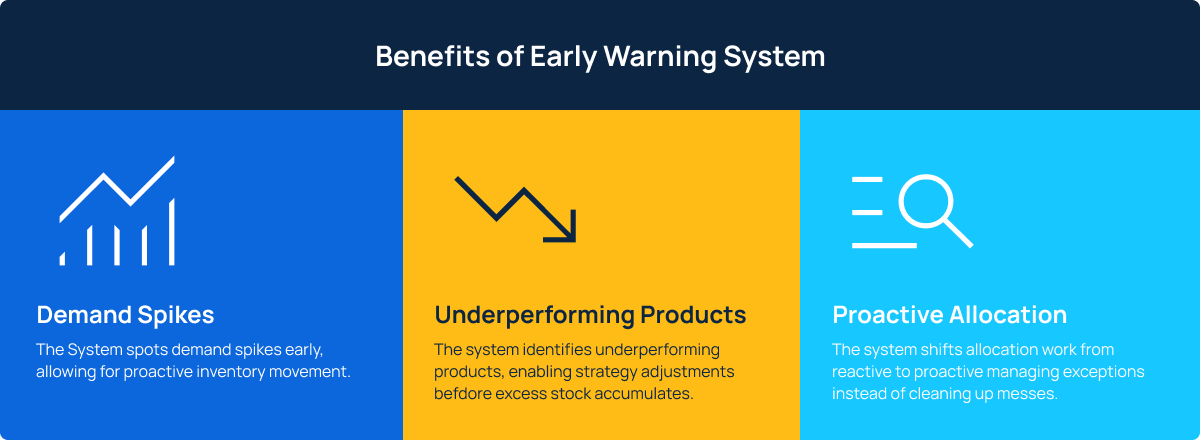
Because the system continuously updates predictions with fresh sales data, it spots emerging issues before they become a crisis. If demand is spiking somewhere, you see it early enough to move inventory proactively. If a product is underperforming, you can adjust your strategy before you're stuck with excess.
This shifts your allocation work from reactive to proactive. You're managing exceptions, not cleaning up a mess.
The Risks Worth Addressing
Is This Too Complicated to Use?
No. The AI handles the complexity in the background. You don't need to understand the models or tune algorithms. The system tests and selects automatically. You see clear recommendations and decide whether to accept them.
The interface shows you what to do and why, without drowning you in technical details or requiring help from a data scientist.
What If the AI Makes Mistakes?
You always have control. AI-driven systems provide recommendations, not mandates. If something doesn't look right, you override it. The goal is to supplement your judgment, not replace it.
Plus, the system learns continuously. When sales roll in, the models refine their predictions. Over time, accuracy improves automatically.
Will This Work for My Business?
Tournament forecasting works specifically because every business is different. The system doesn't assume your demand patterns match some generic model. It tests multiple approaches on your data and uses what works for your products, your customers, and your locations.
This flexibility is what makes it effective across most retail categories. Each has unique patterns; tournament forecasting handles that naturally.
How Long Can You Afford to Wait?
If you're constantly rebalancing inventory, fighting stockouts, or marking down excess product, your allocation strategy is costing you money. The traditional approach of one forecasting method for everything just doesn't work when demand patterns are diverse and trends move fast.
Tournament forecasting solves this by matching each product and location with the forecasting method that works for it. The result is more accurate predictions, smarter initial allocations, dramatically less rebalancing, and inventory positioned where it will sell.
The retailers already doing this are seeing major improvements: forecast errors cut in half, increased sales, leaner inventories, and better margins from selling more at full price.
This isn't theoretical, it's happening now. The question is whether you're going to keep fighting the same allocation battles every season, or use an approach that addresses why those battles exist in the first place.
Ready for a Different Approach?
Toolio's platform uses AI-powered tournament forecasting to help retailers get allocation right the first time. Curious how this would work for your business? Our team can walk you through it and show you what's possible when your forecasts match reality. Let’s talk - Speak to an Expert today!


