Retail Planning's
Grid-Lock Has a Way Out

A Ready x Toolio Perspective on What Comes After the Grid
01

A Billion-Dollar Ghost Town

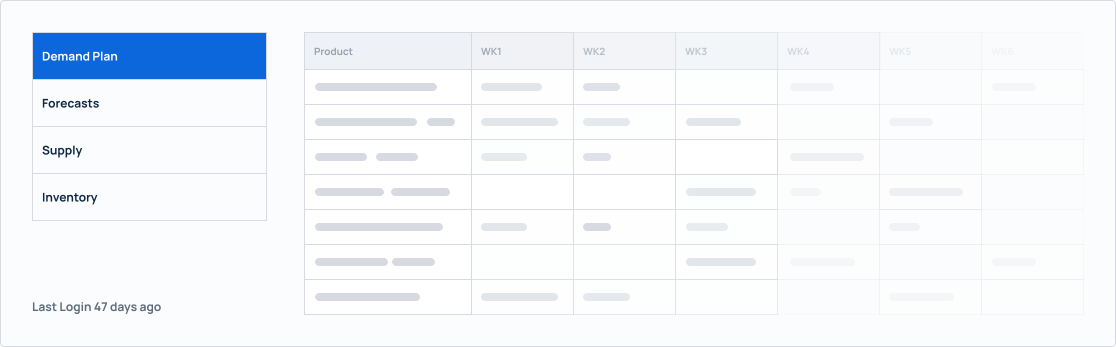
Some of the largest brands and retailers in the world have full merchandise planning platforms deployed. The log-in screen becomes a formality. The real planning happens somewhere else.
This pattern repeats across customer and client environments. A platform goes live, and within months the team drifts back to the process they knew before. Not because the software doesn't work, but because not much has changed in terms of how work actually gets done.
This points to something the industry hasn't addressed directly enough. We are at an inflection point where the planning interface itself, not the underlying logic or the planning discipline, is what's being replaced.
02

The Grid Became the Job

Planning software solved a real problem. It moved forecasting off spreadsheets and into a structured, shared environment. For most organizations, that helped reduce or eliminate reliance on manual docs -- and for a long time, that was enough.
But the grid interface came at a cost. It required planners to do a significant amount of work the software should have been doing. Coordinating across merchandising, finance, supply chain, and stores. Validating assumptions. Reconciling conflicting information. Comparing system outputs to business reality.
Preparing analyses someone else would use to make a decision. Explaining why the forecast changed. Managing overrides. Translating data into defensible recommendations.
Planners built real skill around this work. Many organizations came to depend on it. But what they were depending on was the ability to operate inside a system that required constant human translation to function

"The planner is not just 'using software.' The planner is absorbing friction from the operating model."

Joshua Anderson
CTO, Ready
The grid was the best tool available. For many teams, it still is. But the friction it creates, the hours spent extracting, reconciling, reformatting, explaining, is now the ceiling. Brands and retailers building a planning organization for growth or efficiency (or both) need to ask whether their stack removes that ceiling or reinforces it.
03

The Market Already Made Its Call

Market Signal, September 2025
In September 2025, Anaplan acquired Syrup Tech, an AI-native retail planning platform. The deal was a bet that the calculation engine alone is no longer enough, and that AI-native layers capable of ingesting real-time signals and generating granular recommendations are where the market is heading.
Anderson sees the acquisition as market validation that planning value is shifting beyond traditional grid-based interfaces and toward AI-enabled orchestration layers. "We don't believe the winners will be defined by AI alone, but by the quality of the structured planning data, governance, workflow integration, and trust model underneath it."
The AI layer is only as useful as what it's connected to.
At the board level, that signal is being felt. Executives are pressing for AI that can explain forecast changes in plain language, model scenarios on demand, compare system outputs against planner overrides, and surface exceptions before they become operational problems.
The push for AI transformation is arriving in organizations where the core planning tool still requires cell-by-cell overrides.
The technology to close that gap exists today. Where it stalls is at the organizational layer.
Many brands and retailers face foundational challenges around data quality, process consistency, governance, and cross-functional alignment. Even when the technology is available, the organization may not yet have the operating discipline or user trust to embed AI-driven insights into daily planning decisions.
As Anderson puts it: "The challenge is less 'Can AI do this?' and more 'Can the organization trust it, act on it, and make it part of the planning workflow?'
The grid was the best tool available. For many teams, it still is. But the friction it creates, the hours spent extracting, reconciling, reformatting, explaining, is now the ceiling. Brands and retailers building a planning organization for growth or efficiency (or both) need to ask whether their stack removes that ceiling or reinforces it.
04

Eight Hours vs. Eight Minutes

Consider a markdown scenario. Under the current model: a planner pulls data, reformats it, builds scenarios manually, validates assumptions with the merchant team, gets challenged by finance, rebuilds the analysis, and presents a recommendation; often a week after the clean action window has passed.
In retail, that delay is expensive. Inventory is time-bound. The cost of acting late compounds quickly

CURRENT MODEL

~1 week

Pull data, reformat it
Build scenarios manually
Validate with merchant team
Get challenged by finance
Present a recommendation
Action window has passed

WITH AI LAYER

Minutes

Describe the scenario in plain language
System identifies choices at carryover risk
Models markdown cadences vs. margin targets
Stages per-choice program -- timing, depth, location all accounted for
Multiple scenarios, assumptions documented, trade-offs visible
Planner reviews, stress-tests, approves
The planner shifts from building the analysis to reviewing it, stress-testing it, then making adjustments or approving the proposed changes.

"The medium is becoming language. Instead of building views by hand, you describe what matters and the plan answers. You ask where the risk is, it shows you. You decide the move, it makes it."

Eytan Daniyalzade
CEO and Co-Founder of Toolio
That difference is where the intelligence vs. judgment distinction becomes concrete. AI handles the intelligence layer: pattern recognition, scenario math, data retrieval, exception flagging.
The planner owns the judgment: which scenario fits the brand strategy, what risk is acceptable, where the model is missing context the data can't provide.
Both are necessary. Only one requires a human.

AI HANDLES

Intelligence

Pattern recognition
Scenario math
Data retrieval
Exception flagging
Can be automated at scale

PLANNER OWNS

Judgment

Can be automated at scale
What risk is acceptable
Where the model is missing context the data can't provide
Stages per-choice program -- timing, depth, location all accounted for
Requires a human. Always.
05

Where Judgment Lives

The planning work that moves to autonomous execution: routine reporting, scenario generation, exception flagging, replenishment signals, is the work that's been consuming most of a planner's week. Shifting that to AI doesn't replace planning, but instead, creates the capacity to do more of it.
Here's what can't be automated: evaluating trade-offs, assessing strategic risk, reading competitor and market dynamics the historical data hasn't captured yet, understanding brand context well enough to know when to deviate from the model, and aligning departmental stakeholders around a decision that isn't purely mathematical.

"The planner's day shifts from preparing the plan to interrogating and improving it."

Joshua Anderson
CTO, Ready
Planners stop flying individual planes and start managing airspace. As Eytan puts it: "The highest-value skill shifts from 'can you build and manage a plan' to 'do you know when to trust the agent and when to override it.'"
That's a different job. The skill that matters going forward is knowing which signal to act on, which exception to escalate, and where the model is missing context that only a human can provide. Context the algorithm can't find in historical data because the situation is new.
06

A Different Hire. A Different Evaluation.

Brands and retailers building planning teams for the next five years need a different profile than the one that defined the last decade. The skills that have historically been most valued: grid fluency, spreadsheet expertise, and process management become less differentiating as AI absorbs the manual burden. Economic reasoning, business judgment, scenario interpretation, and the ability to work with AI-generated analysis matter more.
Planners who can interrogate a system recommendation, identify where the model is missing context, and communicate a defensible decision to finance and merchandising will be more valuable than planners who are fast at building the analysis themselves. The pyramid inverts, as Eytan describes it: fewer people doing execution, more people governing intelligence. That requires a planning environment designed to support that kind of work.
Brands and retailers actively evaluating planning platforms should be asking different questions than they were five years ago.
"How intuitive is the UI?" matters less now than whether the platform can expose trusted planning data to an AI layer, explain forecast changes clearly, and let planners interrogate the plan in plain language.
The governance question matters too. There should be a record of what was decided, why, and by whom. It's easy to pass this off as a nice-to-have, but that's what makes AI-generated recommendations actionable rather than advisory.
07

Planning in a Post-Grid World

The brands and retailers that come out ahead won't be the ones who bought the most sophisticated grid. They'll be the ones who recognized the interface as the constraint and moved past it.
This is where the structure underneath the AI layer matters. The difference between a planning copilot and a planning operating model is whether the system can turn a planner's intent into a governed, auditable outcome, or whether it stops at the recommendation. Intelligence that can reforecast, reallocate, and propose transfers against a live plan, with every action attributed and reversible, change what "acting on AI" actually means in practice. The insight and the execution live in the same place. So does the audit trail.
50%

Toolio MCP Server -- June 2026

Toolio released its MCP server in June. Half of its customers are already running it against live planning decisions. The shift is already in motion.
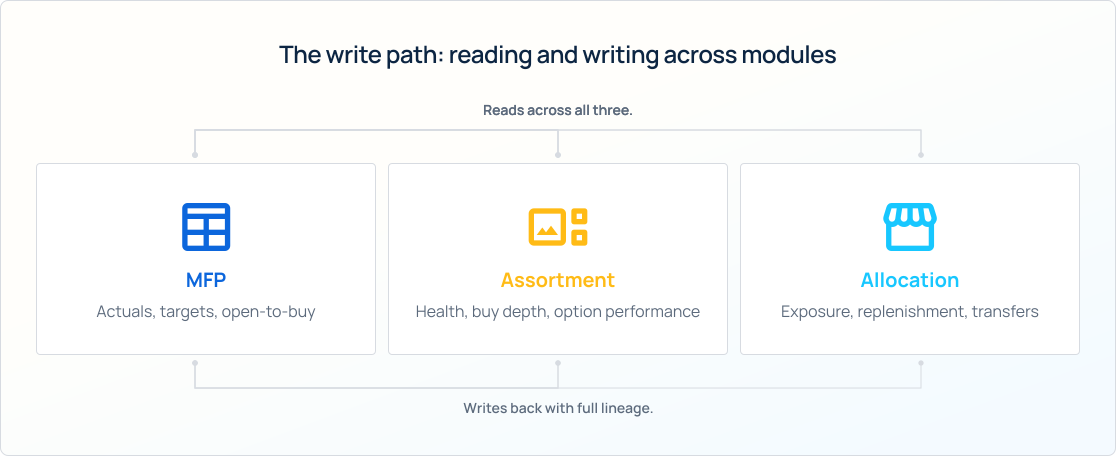
What makes the foundation matter is what it can write to. A question like "where are we exposed heading into back half?" doesn't live in one module. The answer pulls from MFP actuals, assortment health, and allocation exposure.
Reading across those modules is one challenge. Writing the revised decision back into the system of record, with full lineage across MFP, Assortment, and Allocation, on a shared planning ontology, is the other. That's the distinction between a planning analytics tool and a planning operating model.
Most AI tools stop at the recommendation. The ones that close the loop, that write the approved decision back into a governed, versioned plan, are where outcomes actually happen.
08

Two Patterns Worth Understanding

Ready's client work surfaces two patterns that illustrate what the transition actually looks like.

01

New platform deployed. Adoption stalls.

A new platform gets deployed but adoption stalls, not because planners distrusted the technology, but because they weren't yet confident enough to rely on it daily. With limited time allocated to training and change management, the old process felt faster and lower-risk. The platform sat underused.
The Lesson: Planning transformation can't be treated as a system deployment alone. Without investment in user confidence, operating rhythm, and decision governance, the legacy process continues to live outside the platform.

02

Capable team. No capacity for forward-looking work.

A capable team running on manual processes had almost no capacity for forward-looking work. They could react to demand signals. They couldn't scale forecasting discipline or build proactive visibility, regardless of individual skill.

Both point to the same thing. Technology will continue to advance. The organizations that benefit are the ones that pair it with the operating model to support it: a trusted, embedded planning environment the team relies on to make decisions, not just generate reports.

"The leaders who sit with these questions now will be ready when the answers start to matter. The ones who wait will be working them out under pressure."

Eytan Daniyalzade
CEO and Co-Founder of Toolio

The interface is changing. The judgment needed to manage the airspace isn't.

Ready is a consultancy focused on building forward-looking planning operations for modern retailers.
Toolio Brand Logo
Toolio is a retail merchandise planning platform. Together, we help brands and retailers make the shift from manual planning processes to AI-enabled operating models.