


Something has shifted in how finance and planning talk to each other.
It started with inventory. The past few years put inventory decisions under a level of scrutiny most planning leaders had not experienced before. Demand swings, supply chain disruption, and a series of very public over-inventory writedowns put the question on every CFO's radar: how confident are we in the data behind our buy decisions?
That question hasn’t gone away. If anything, it has become more specific.
You’re now fielding questions you weren’t being asked five years ago. Not just "what is our inventory?”
Those navigating these conversations well aren’t necessarily the ones with the most accurate forecasts. They are the ones who can answer the how and the why, not just the what.
What CFOs Are Actually Asking
The questions coming from finance have changed in character. They are less about the plan as a document and more about the plan as a decision-making record.
A few that planning leaders are hearing more frequently:
These are not hostile questions. They are governance questions. CFOs who lived through 2022 and 2023 inventory cycles are building the habit of asking them. Planning leaders who can answer them clearly are in a fundamentally different position than those who cannot.
Why the Gap Is Wider Than It Looks
Most planning organizations can answer the “what.” They have a plan and a current forecast. They can tell you where they stand against plan.
The how and the why are harder.
Why did the forecast for that category change between week four and week six? What was the original demand basis for the new style that missed? When the team revised the OTB in March, what drove that decision and who approved it?
For most organizations, answering those questions requires someone to reconstruct the answer from memory, email threads, and spreadsheet versions that may or may not be current. The answer is usually approximately right. It is rarely defensible in the way a CFO or board is now expecting.
That gap matters for three reasons.
First, it makes post-season reviews less useful than they should be. If you cannot reconstruct what happened clearly, you cannot change the process that produced it.
Second, it creates personal exposure for planning leaders. When decisions are undocumented, accountability defaults to whoever is in the room. That is not a fair system and it is not a stable one.
Third, it is becoming a competitive disadvantage. The organizations building documented, auditable planning processes are making better decisions faster and learning more from each season. The gap between them and organizations still running on reconstructed narratives is widening.
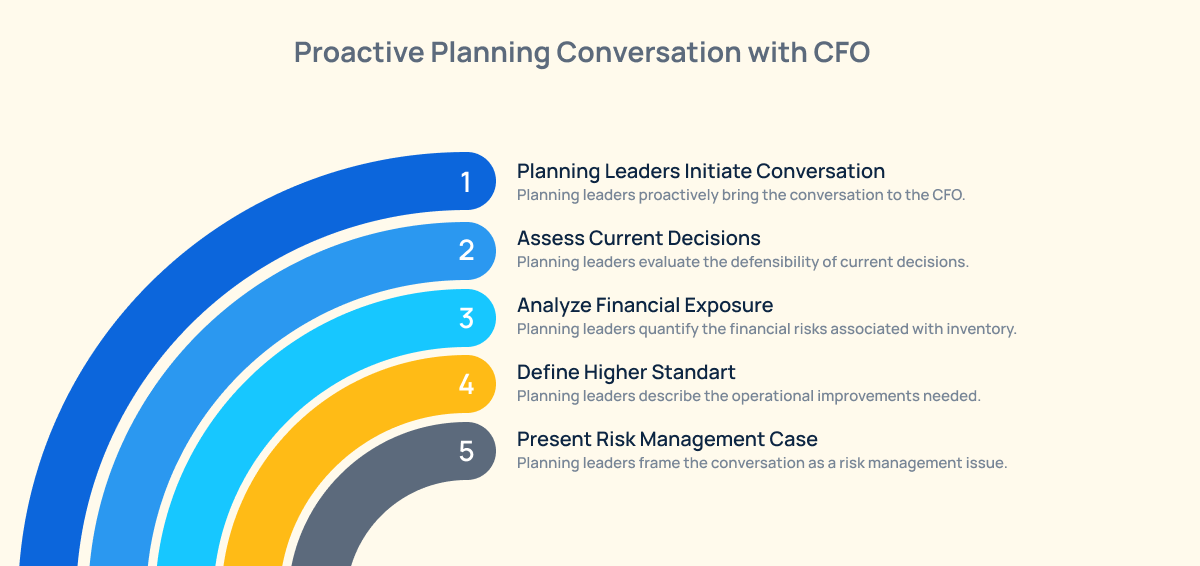
What the Conversation Looks Like When Planning Leads It
The planning leaders who are getting ahead of this are not waiting for the CFO to ask the hard questions. They are bringing the conversation proactively, with a clear picture of where their process stands and what it would take to get to a higher standard.
That conversation typically covers three things.
What decisions we can currently defend
An honest accounting of where the documentation exists and where it does not. Not framed as a gap to apologize for, but as a baseline to build from.
What the financial exposure looks like
Excess inventory, markdown rate, and the cost of decisions that could not be interrogated and therefore could not be corrected. These are numbers that resonate in a finance conversation in a way that "we need a better planning system" does not.
What a higher standard looks like operationally
Not a technology pitch. A description of what the process looks like when forecast rationale is captured, overrides are logged, and the whole organization runs off a single version of the plan. What that enables in a post-season review. What it enables when a planner transitions. What it enables when a vendor challenges a PO.
When you can have that conversation, you’re not asking finance for budget for a planning tool. You’re presenting a risk management case backed by numbers. That is a different conversation with a different outcome.


