


Can you trace any number in your plan back to its source in under five minutes?
Most brands and retailers have deployed AI forecasting. Far fewer have solved what comes after: getting planners to trust it, getting leadership to defend the decisions it drives, and building the institutional record that lets you actually learn season over season.
That gap is costing the industry more than most want to admit. $70-140B in excess inventory is produced annually. 20% of monthly profits are lost to inaccurate size purchasing alone. These are planning failures. And most of them trace back to decisions that were never properly documented or interrogated.
Three capabilities separate the organizations that fix this from the ones that keep repeating it: forecasting explainability, data defensibility, and planning lineage.
Your AI Is Working. Your Planners Are Not Using It.
Here is a pattern you’re likely to recognize. The model outperforms your old approach on every error metric. And yet planners are either rubber-stamping outputs without scrutiny or overriding them wholesale and running on instinct.
Both modes destroy the ROI of your AI investment.
Blind acceptance is the more dangerous of the two. New launches, promotional windows, and supply disruptions are exactly when AI models are most likely to be wrong. And exactly when unchallenged outputs cause the most damage.
Blanket override is just expensive. You are paying for a forecasting system and running the business the same way you did before you had it.
The root cause of both: the model is not showing its work.
82% of planners report confidence in AI-based decisions within six months when the system surfaces its reasoning. Without that, the number drops to 34%. That gap is the difference between a deployment that works and one that does not.
What Explainability Actually Means
Explainability is not about model transparency in the technical sense. It is about making forecast logic legible to the people who act on it.
What planners need to see:
Driver attribution. What is actually moving the forecast, in plain language, not model coefficients. Trend acceleration, promotional lift, analogue performance.
Confidence intervals. Point forecasts are fiction. Planners need to know the range and what is driving the uncertainty.
Anomaly flags. The model should tell planners where to look. It should not expect them to scrutinize everything.
Historical scenario context. What happened last time conditions looked like this.
Natural language rationale. "Why did this forecast change?" answered in English.
The goal is real human-AI collaboration. The model handles volume and pattern recognition. Planners handle vendor relationships, trend conviction, brand positioning. That handoff only works when planners can see into the model.
The Defensibility Standard Has Changed
Boards and CFOs are asking harder questions about inventory. You need to answer for decisions with more than narrative and hindsight.
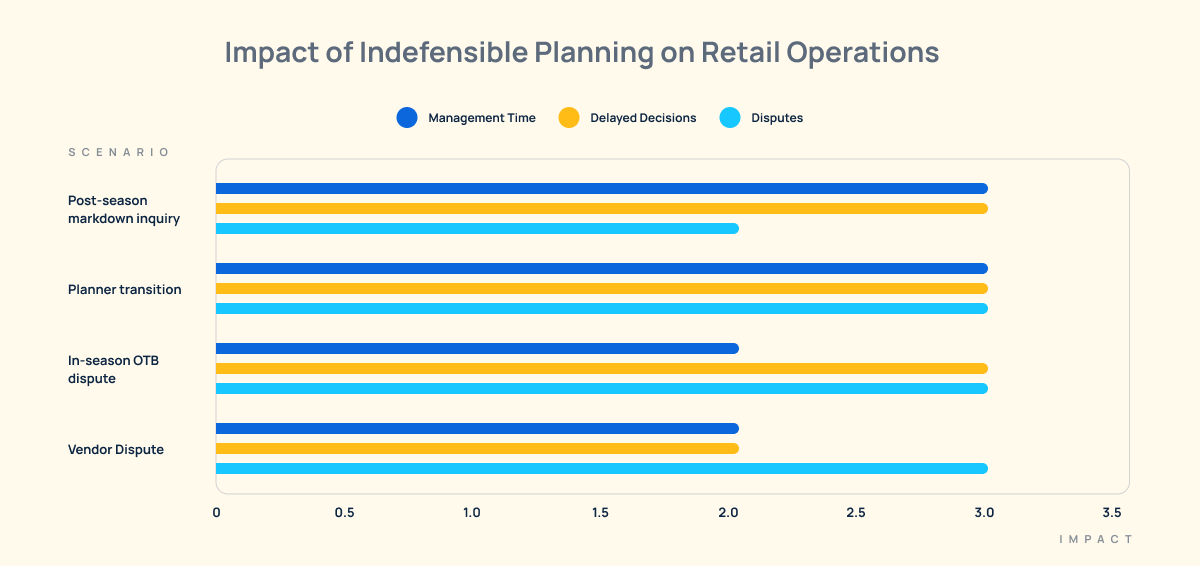
Four scenarios that expose defensibility gaps:
Post-season markdown inquiry.
A category comes in 30% under plan. Inventory sits, markdowns follow. Without documented planning records, your answer is reconstructed from memory and email threads. It does not prevent the same outcome next season.
Planner transition.
A senior planner leaves mid-season. Their forecast logic, analogue selections, and in-season assumptions go with them. The team inherits a plan they cannot understand.
In-season OTB dispute.
Merchant and planning disagree on a receipt call. Without an audit trail from original plan to current forecast, the conversation defaults to opinion.
Vendor dispute.
A supplier challenges a projection or forecast. You need to demonstrate that the demand basis changed materially. Without documentation, that is a harder and more expensive conversation.
Every one of these scenarios is manageable with a documented planning process. Without it, each carries a tax in management time, delayed decisions, and disputes that never show up on a P&L but compound every season.
Lineage Is the Infrastructure Everything Else Runs On
Lineage is the documented chain from raw data to commercial decision, and from decision to outcome. Not just version control. The full answer to: where did this number come from, what was done to it, who touched it, what decision it drove, and what happened?
This matters most in new product forecasting, and it gets documented least. When a new style misses, can you answer: was the analogue wrong? Was the trend signal accurate? Was buyer conviction systematically skewed? Without lineage, you cannot. Which means you repeat the same errors.


