Q3 2026 Edition
In-Stock
The unhedged truth about retail planning.

“In-Stock” is Toolio’s quarterly look at what’s actually happening in retail planning, drawn from conversations with planning leaders, implementation partners, and the Toolio team.

I’ve called this the early innings of an AI shift in retail technology, and said most people were underestimating how fast it would move. I still think we are early. What I underestimated was the pace.
There’s already a lot of change on the field. Agents are getting real adoption across the enterprise, and Toolio customers are leaning in fast. We released our MCP server not long ago, and half of our customers are already using it, running it against real planning decisions, the ones they answer for.
What I hear from planning leaders has changed with it. The question is no longer whether AI reshapes their work. It is how. How do you actually adopt this, and what happens to the role when you do.
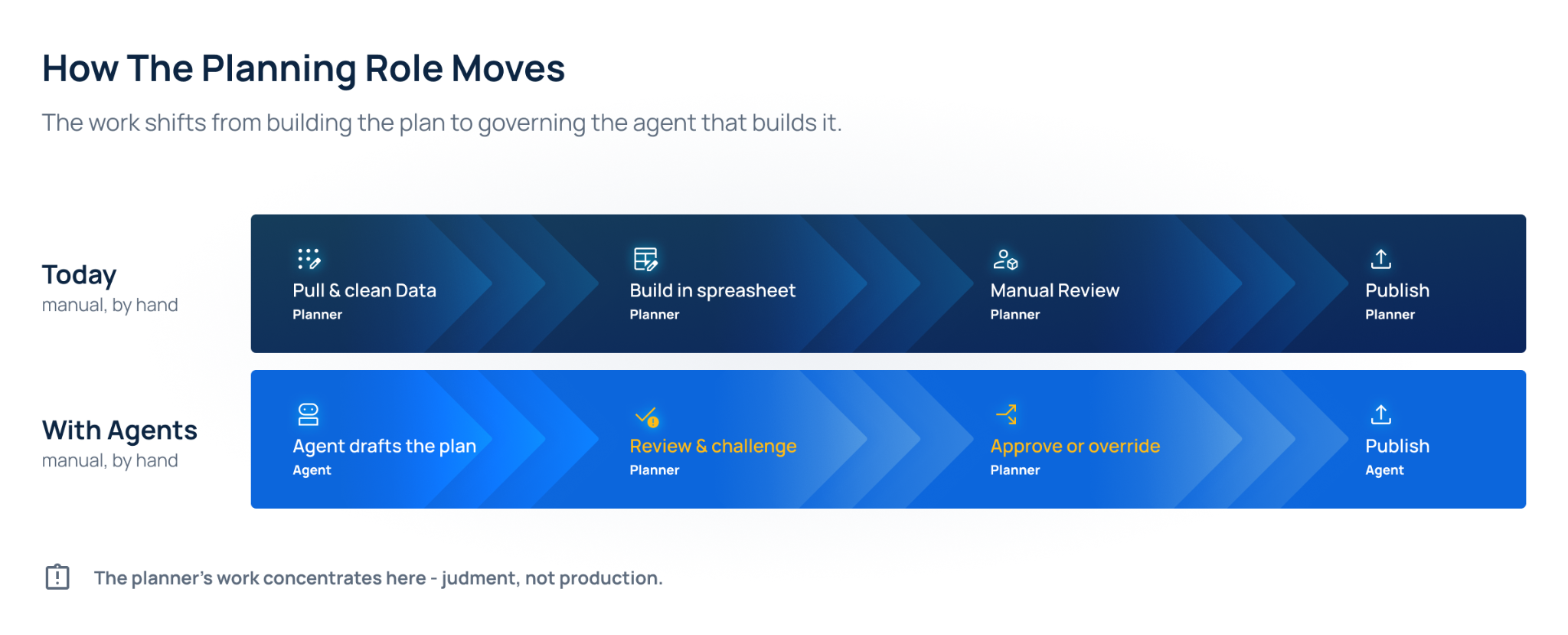
The planner's job is being rewritten. The work is moving from building plans to governing the agents that build them for you. The teams that adapt will run leaner and sharper than the ones that don't. Getting there comes down to four things: the right data, the right context, the right framework to manage their agents, and the right way to review their work.
Each of those is a decision you can start making now. Let me take them one at a time.
The AI conversation in planning keeps skipping something obvious. The models aren’t the bottleneck. Frontier models solve math olympiad problems and reason through code, contracts, and clinical research. What they can't reason through is your open-to-buy workbook.
Fourteen tabs. Merged cells. Color-coded comments that mean different things to different people. A "do not touch" column whose rule nobody remembers. SKU history in three places. Last year's actuals overwritten in March.
That’s a data problem. If you want an agent helping with forecasting, open-to-buy, or markdown calls, the data has to be structured at the transaction level, clean at the SKU level, and unambiguous in what it means. The ceiling on AI in this category is the workbook. The first move is deciding to leave the spreadsheet and move to a real data model.
Clean data tells an agent what happened. It does not tell the agent why, or what you decided to do about it. That part lives in people's heads.
Ask most planning teams what walks out the door when their best merchant leaves, and they can’t answer it. Retail planning rarely has real standard operating procedures. What it has is institutional memory. Which styles flopped three seasons ago and why. Which promotions cannibalized full price and which ones grew the base. Which scenarios you considered, and why you chose one over the others. None of that is in your ERP or your BI dashboard. It’s in one person's head and a shared Excel nobody else fully understands.
An agent with clean data and no context will make confident, wrong calls in exactly the categories you know best. So the context has to be captured: the decisions, the scenarios considered, the rationale attached to the plan. Do that, and two things happen. The memory stops leaving when people do. And it becomes something an agent can use to produce accurate calls.
This is the part that changes the job itself. When an agent can generate a first-draft plan in minutes, pulling historical performance, current trends, vendor constraints, and cannibalization logic, the planner's first interaction is no longer building the plan. It is reviewing it, challenging it, and deciding whether to trust it.
The highest-value skill shifts from "can you build and manage a plan" to "do you know when to trust the agent and when to override it." That’s a different job, a different skill set. A team of eight running seasonal buys, weekly reporting, and allocation starts to look like a smaller, more senior team that spends its time on the exceptions and the judgment calls. The pyramid inverts. Fewer people doing execution, more people governing intelligence.

We’re not painting a headcount story here. A modern pilot doesn't fly the plane by hand. The autopilot does. But you still need the pilot, and you need them to know when the autopilot is wrong and when something is happening that it has never seen. Governing planning intelligence is the same job: set the objective, validate the logic, catch the cases the model was never trained for.
Which brings me back to the grid. Planners have always known the grid was just the medium. The insight underneath it was the point. For decades the job has meant bending a spreadsheet by hand. Conditional formatting to flag a cell when sell-through slips. Hidden rows to cut the sheet down to the twelve classes that matter this week. That instinct for what to look for was always the real work.
The medium is becoming language. Instead of building views by hand, you describe what matters and the plan answers. You ask where the risk is, it shows you. You decide the move, it makes it. Planning becomes a conversation and a review, not an afternoon of cell manipulation. Software engineering already made this jump. Engineers who used to read code line by line now describe the change they want and review the result. That took about eighteen months. We think planning makes the same jump, and faster.
Most planning teams have more questions than answers right now, and that is the right place to be.
The work is to start asking the questions. What data are you ready to hand an agent? What context still lives only in your people's heads? How will you govern the agents once they are doing the work, and what does your team look like when they are? The leaders who sit with these questions now will be ready when the answers start to matter. The ones who wait will be working them out under pressure.
We’re building toward all of it. We have shipped a structured planning model, an MCP server so your agents and ours can work against the same planning data, and a skills library for the recurring planning jobs. We’re building our agent hub to govern the agents that do the work and take action on it, and starting on capturing the context behind the plan so the reasoning lives with the numbers.
The goal is simple. Let a smaller, more senior team govern a much larger planning operation than it could ever manage by hand. The job is changing, and the tools are changing with it.

Most retailers who have brought AI into planning have pointed it at one job: watching the plan. It flags the exceptions, a category running 8% under, a store sitting on excess cover, a style breaking its forecast band, and automates the plan-versus-actuals reporting that used to eat the first days of every month.
That’s real progress, and it’s also a rearview mirror: AI describing the past with precision, then going quiet exactly when the hard part begins, deciding what to do about it.
The next leap is an AI that moves out of the reporting seat and into the role of a strategy partner, one that helps you shape the plan going forward instead of grading the one you already made.
When the system flags that outerwear is tracking 8% under plan, the planner is now holding a problem, not a solution. Reallocate from overstocked stores? Pull markdown timing forward? Adjust the outstanding buy? Chase the categories overperforming to recover the margin?
Each is a legitimate strategy with different trade-offs, and the AI, having narrowed the problem down, has left the whole decision on the planner's desk. AI has made monitoring faster without making decisions better.
The shift worth investing in is simple to state and hard to do well. The same intelligence that flags the exception should also propose the responses.
Instead of stopping at "outerwear is under plan," a strategy-partner AI hands the planner two or three executable paths to close the gap. Reallocate cover into the stores still selling through. Rebalance open-to-buy toward categories showing real trend velocity. Bring markdown cadence forward to defend full-price sell-through.
Each option arrives with its projected impact on margin, inventory, and sell-through, so the planner chooses between real strategies rather than starting from a blank page. The AI moves from describing variance to generating the paths out of it.
Generating options is only half of it. What separates a strategy partner from an autopilot is that you do not act on the proposals blindly. You run them forward and compare outcomes first.

Simulate each strategy against a season of conditions. What does the reallocation do to stockout risk in the stores you pulled from? What does pulling markdowns forward cost in full-price margin, and does the improved sell-through pay for it? Where does each option break if demand comes in soft?
The planner picks the winner with evidence in hand, and can defend that choice to a merchant or a CFO with the trade-offs made explicit.
A strategy is only as good as your ability to execute it coherently, and in most operations the plan does not live in one place. Merchandise financial planning sets the targets and the open-to-buy. Assortment planning decides the range, depth, and choice count. Allocation and replenishment push units to stores.
Too often these are separate systems held together by exports and reconciliation, and an AI-generated strategy fractures the moment you execute across them. Chasing a trending category has to ripple up into the financial plan, reshape the assortment, and change what allocation sends to which stores. If each lives in its own tool, the planner re-keys it all by hand and the advantage evaporates in the handoffs.
An integrated planning solution is what lets the AI connect the dots. When MFP, assortment, and allocation and replenishment share one data model, a strategy can be traced from the financial level down to the store-and-SKU decisions that deliver it, with constraints flowing back up just as cleanly.

Closing the outerwear gap by chasing a trend carries an open-to-buy, an assortment, and an allocation implication at once, and the AI sees all three. Once the planner chooses, the strategy becomes plan data directly rather than getting re-keyed into three systems.
That is the difference between AI that gives advice and AI that changes the plan.
None of this is AI replacing planners. The role moves up a level. Today the planner reads reports and reacts. In the strategy-partner model, the planner sets the goal, defines the guardrails, judges the strategies, and owns the call. The work doesn’t shrink, instead it becomes more strategic.
The retailers pulling ahead will be the ones who stopped asking AI only what happened and started asking it what to do, and whose systems were connected enough to actually do it.
Each quarter, we go back through our customer and prospect conversations -- discovery calls, demos, planning sessions -- and look for what planners and leaders are telling us directly.
One theme kept surfacing across every type of retailer we talked to, regardless of size, category, or channel mix: the business has outgrown how it plans.
New wholesale accounts. More store doors. Multiple brands. Channels that didn't exist a few years ago. The growth is real. The planning infrastructure largely hasn't kept pace.
The story we heard most often went something like this: a brand starts as DTC, adds wholesale, picks up a few retail doors, maybe opens outlet locations. Each move makes sense. Together, they create a problem nobody fully anticipated.
One customer described going from a straightforward direct business to five channels with hundreds of style-color combinations. Another built a full retail footprint from zero in under three years. The operations scaled. The planning processes, mostly, were still built for a simpler version of the business.
Wholesale is where the pressure shows up most clearly. Selling into major retail partners means committing to inventory before you have firm orders.

"We don't get all the booking orders in time from accounts. So often we have to buy blind. What do we think is going to happen to cover what we're forecasting and what the accounts will want?"
We heard a version of this last quarter too, but it's showing up differently now. As brands add channels, they're often pulling from the same inventory pool, and there's no real system to manage the conflict.
One customer described e-commerce and wholesale drawing from the same units simultaneously. A wholesale partner can come in and take the entire stock in a single day. Everything downstream adjusts. There's no prioritization logic. The fastest channel wins, regardless of which one matters more to the business.
For some brands, the stakes are even higher. One customer told us a single wholesale partner represented close to 60 percent of their revenue. When that account moves, everything else moves with it.
The replanning pressure we covered last quarter hasn't gone away — it's just compounding. More channels means more variables to track, more places for inventory to get pulled in the wrong direction, and more catch-up when it does.
Supply chain complexity came up a lot this quarter, not just lead times, but the structural friction of working with vendors who operate on their own terms.
MOQs and pack constraints don't always line up with what demand is actually calling for.
"The vendor has to ship 5,000 pieces to do the color, but you can call off in smaller quantities."
"We have to buy in sets. The demand is 700 large, 500 mediums, 500 smalls. What that really means to the vendor is 500 sets and 200 large singles."

Different brands operate on entirely different buying rhythms. One customer manages suppliers where one brand allows monthly replenishment buys and another locks you into a single seasonal commitment with no flexibility after the fact. Planning for both at the same time, on the same team, with the same process isn't simple.
The back-and-forth on orders adds substantial time. "It can take four to six weeks to get a response from a vendor. They have to place orders with suppliers, do the containerization, and give us back our POs," one customer told us. By the time confirmation comes in, the window has narrowed.
Some businesses are dealing with demand volatility that goes well beyond normal seasonality. One customer whose sales are tied directly to the outcome of professional sports games put it this way:
"Our business is so win-loss, performance-dependent. If we looked at a team's trend over the last four weeks and compared it to what their business looks like in a playoff run, it would be like night and day. We have a team that runs up to 100 different models looking at historical performance by teams that have won at this level."
Even outside sports, one-time demand spikes are a real planning challenge. When something moves fast, you need inventory, but those spikes have to be treated as exceptions, not fed back into future forecasts.
"Those little spikes are difficult to forecast. It's so important to understand these spikes could be a one-time thing and should not be used in the forecast going forward."
The teams navigating this are good at isolating the signal from the noise and keeping forecasts clean.
What connects all of this is how fast the business is moving and how fast planning can respond.
Channels grew faster than the processes supporting them. Vendor complexity increased faster than systems adapted. Demand signals shift faster than re-forecast cycles can keep up.
The teams feeling it most are the ones running planning processes designed for a simpler version of their business.
Perspectives from consulting and advisory partners working with Toolio and enterprise retailers every day
Consultants and system integrators sit in an unusual position. They've seen dozens of implementations across hundreds of brands. They know what the pitch left out. They're in the room when things go sideways. They have no reason to oversell.
We asked our advisory and SI partners what they're actually seeing this quarter. Here's what came back.
One points to org and people, change resistance that shows up quiet rather than loud: the team runs the new tool and keeps the old spreadsheet “just to check” until the speed advantage disappears, and every AI recommendation gets re-validated by hand anyway.

Another points to process and workflow fit: the tool optimizes the math but doesn't automate the ritual the team already runs, so it becomes a parallel system instead of the system of record.
A third puts data readiness right behind people, on the logic that clean data with no trust still doesn't move.
“The model is rarely the blocker. The planner who's been right for fifteen years with a spreadsheet is.”
A small vendor with a real AI edge and a credible hyperscaler standing behind it now reads as a legitimate alternative to the big incumbent, not a risk to screen out. What decides it instead is who's running the evaluation: an IT-led process still defaults to the safe, familiar name, Oracle / IBM, while a business or operational leader pushes for the best tool for the job, size aside.

Either way, the incumbent retailers actually measure against usually isn't the platform they're replacing. It's Excel. That hasn't moved much at the very top of the market, but it's shifting fast in the upper-mid market, where focused platforms have become the thing to beat.
Plenty of well-funded planning platforms were built for the clean, single-channel DTC brand, and it shows the moment a retailer has real wholesale exposure.
A department store or multi-channel wholesale business needs a vendor that can plan to a retailer's calendar, manage chargebacks, and reconcile sell-in against sell-through, not a prettier assortment demo.
One partner pointed to a unified-platform story from a legacy player as the kind that resonates with larger retailers for exactly this reason: it speaks to complexity the DTC-first platforms haven't had to solve for yet.
What's working is co-selling around a shared customer outcome, vendor and partner in the same room, dividing the work by who's actually credible on what, rather than one side handing off a lead and disappearing.
What keeps failing is the opposite instinct: vendors who treat a partner as a logo on a slide and a referral pipeline, hold the customer relationship tight through close, then go quiet on delivery.
Partners are direct about the fix. It takes a dedicated team on both sides that actually gets time to define the relationship, or neither side benefits.
The retailers getting this right treat the rollout as a knowledge-capture exercise instead of a software install, pulling the people with distinct, undocumented knowledge into the design sessions and encoding the senior planner's heuristics into rules the system can use.
The ones getting it wrong assume the data will speak for itself and watch that knowledge walk out the door at the next departure, still convinced no system could replicate a judgment call a person has been making for years. The real gap is that they never gave the system the chance to learn it.
Not the roadmap pitch, the one still running on Tuesday. That means daily reallocation and replenishment: flagging the size, store, and SKU about to stock out or pile up, and recommending the transfer or buy adjustment with the reasoning shown, so a planner can verify it in seconds.
It means weekly insights that actually cover the end-to-end footprint instead of a single channel. It means AI absorbing the customer service queries that eat a team's time so people are freed for higher-value work. Different answers, same instinct: pick the workflow that's measurable in weeks, not the platform that's impressive in a demo.
That instinct carried through to the advice on evaluation itself: run it against your own real data, on a workflow that actually hurts, before you sign anything, and if no one in-house can see your own blind spots, bring in someone who can.

See Toolio in Action
The best way to understand what Toolio could do for your team is to start a conversation.


